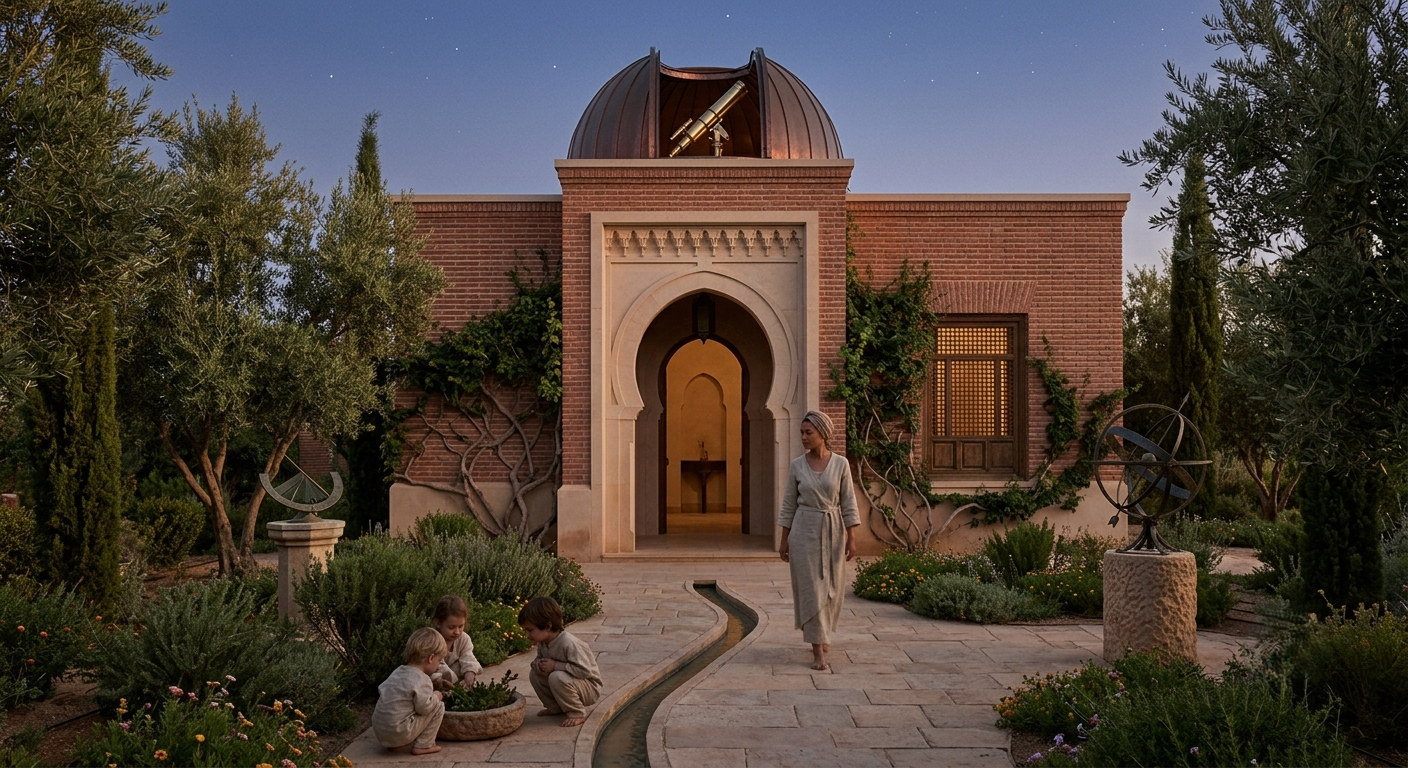
Co-Create Humanity's First Hermetic Tech Incubator
Cosmological Incubator
The incubator's architecture draws from the lineages of the 16th century hermetic observatory Uraniborg and the 2000 year old Planetary Temples of India.
StarGate Labs is a place where hearts and minds contact the cosmos in a visceral manner, and where cosmological technologies get built with rigor. The architecture of the space is the embodiment of the soul of our work, the research. It isn’t a container for the work — it’s part of the work. The space itself supports, illustrates, and invokes the guidance ‘cosmological technology’ requires, a living framework.


Step past the threshold and the temple like exterior morphs into a tech incubator and a cosmic town hall. This isn’t a dry startup lab or academic laboratory. It’s a breathing space, built around the principles of cosmic orientation and the spirit of guidance, ever-present. That guidance takes more than one form here — wisdom keepers past and present, rigorous study and practice, and living inquiry into what a technological embodiment of guidance
Roles for the Space
The same architecture holds the potential to facilitate different roles — for the teams doing the work, and for the public who come to encounter it. A Incubator, a temple and A cosmic Town hall.
Pilot Projects
A working list of cosmological technologies currently being explored — not fixed projects, but examples of the kind of work this incubator exists to develop. This is where collaboration is most needed right now.
The Astrolabe (star-taker), Reimagined
Before clocks, GPS, or modern navigation, this single instrument handled the era’s celestial and daily calculations — considered the ultimate physical manifestation of “as above, so below,” mathematically mirroring the living relationship between cosmos and earthly matter. A first contemporary test case is now in development: a wearable, contemporary descendant of the astrolabe (star-taker) — correlating breath rate to sandhyas (dawn, dusk, and other twilight junctures) and wider celestial cycles (conjunctions, equinoxes, eclipses), with AI as an interpretive layer rather than a replacement for direct perception. Not a replica of the instrument, but a working test of its underlying principle: technology as a bridge between celestial timing and embodied state. A list of other pilot projects is also available for potential collaborative teams.
Music of the Spheres
Music of the Spheres: Western and Eastern musical scales still carry a legacy from Pythagoras and Kepler, who linked specific notes to planetary qualities. What would it mean to measure that relationship with real rigor today?
Talismanic Dimension of Wearables
How can a wearable carry a cosmological or talismanic component — technology worn as much for meaning as for measurement?
Intuitive AI
How can an AI Persona be developed to enhance the intuitive faculties of humanity?
BioGeometry-informed instruments
Based on Dr. Ibrahim Karim’s work — an exploration of how shape, sound, color and subtle energy fields act as design inputs for technologies.
Strange Metals & the Physics of Threshold
Semiconductors sit at a literal threshold — neither conductor nor insulator. Superconductors show electrons behaving as one coherent whole rather than countless separate parts, and “strange metals” exhibit behavior physicists have modeled using the same mathematics as black hole horizons. Sacred sites are thresholds too — places where the multi-dimensionality of our being is revealed to us. Pilgrimage sites often show a parallel signature at a different scale: piezoelectric quartz and geomagnetic anomalies converting mechanical stress into measurable electrical charge. A pilot project could explore this in both directions — using the traditional, cosmological reading of a site to guide where and what to measure, and letting the measurements themselves inform and refine that reading.
Open Questions
Applications: We’re not yet accepting formal applications for pilot projects — a weekly working session for early collaborators may be the right next step.
Development Pipeline: What does the development pipeline look like here — closer to a traditional tech startup, a research lab, or something else?
Collaboration Format: Will pilot teams work in person, remotely, or both?
If you’re already building something like this, what would collaboration offer you?
Cosmological Technology Catalogue: The Franklin Institute displays an extraordinary collection of artifacts representing the horizontal timeline of technological innovation — flight, photography, and more. An interesting exploration would be organizing such a collection along the multi-dimensional cosmological maps StarGate Labs has been developing. A vertical, tattva-based catalogue asks a different question: not when a technology was made, but what level of reality it actually engages. This reveals kinships across eras that a timeline alone would miss, and it turns cataloguing into a design question we can ask of every technology we build here: not just where does this sit, but could it be designed to reach one level deeper?
Visual History — Spaces of Cosmic Orientation
For over 4,000 years, humanity has built spaces to encounter the planets—from Egyptian star temples to Islamic observatories, from Tycho’s alchemical laboratory to modern planetariums. Explore a visual timeline that shares a alternate history of Planetary Spaces.